
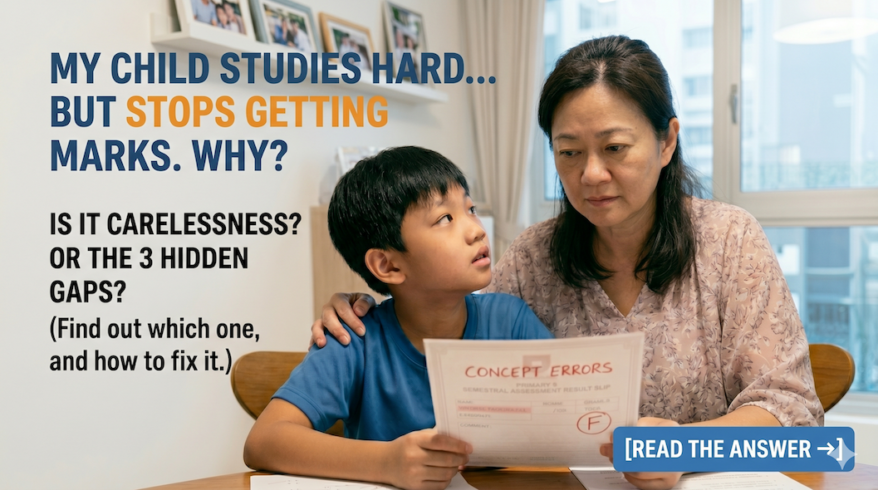
The scene is the same in many Singaporean households.
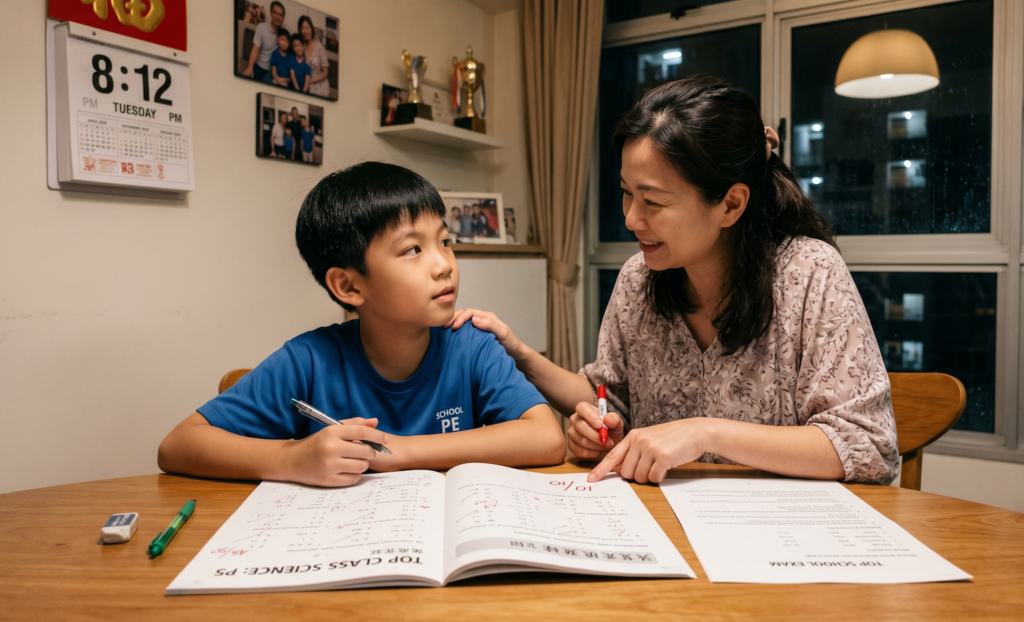
It’s 8:00 PM on a Tuesday. Your child is at the dining table, assessment book open, focused.
They finish the practice paper, you mark it together, and they’ve actually done quite well.
You feel a sense of relief—they’ve got this.
Then the actual exam results come back.
The marks are lower than what you saw at home.
You’re confused.
You’re frustrated.
You ask, “What happened? We practiced this!”
And your child looks at you with that blank, defeated expression and says, “I don’t know.”
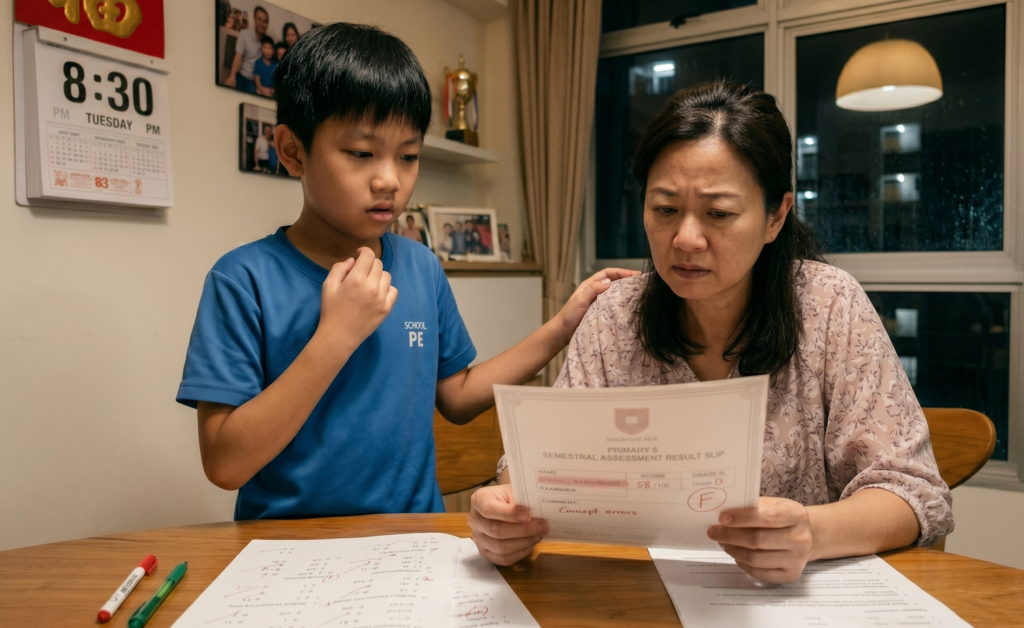
That “I don’t know” is the most honest answer they can give. They aren’t being defiant or lazy. They genuinely cannot identify where their understanding broke down between the dining table and the exam hall.
I’ve seen this pattern hundreds of times in my years as an educator. Parents often come to me thinking their child is just “careless” or “needs more practice.” But after working with countless P4 to P6 students, I can tell you: the answer is almost never what parents expect. It’s not about how hard they are working; it’s about where the connection is failing.
Why “Study Harder” is the Wrong Advice
When we see disappointing results, our Singaporean “kiasu” instinct kicks in:
– Buy another top-school paper.
– Sign up for another intensive drill.
– Sit at the table for two hours instead of one.
But here’s the brutal truth: studying more of the wrong thing only produces more of the same result.
If a child has a fundamental misunderstanding of a concept, practicing more papers just reinforces that wrong mental model. You are essentially helping them “perfect” their mistakes. More hours don’t fix a broken compass; they just move you further in the wrong direction.
We need to stop measuring “effort” by the thickness of the stack of finished worksheets. Instead, we need to look at the gaps that are preventing that effort from turning into marks. In my experience, it usually boils down to three specific things.
The Three Gaps That Drain Marks
Gap 1: The Language Gap (The “Keyword” Trap)
This is especially painful in Science. Your child understands the concept perfectly. They can explain it to you in plain English. But when the paper comes back, the “Open-Ended Questions” (OEQ) are covered in green ink with the dreaded “X” or “rephrase.”
For example, a child might write, “The plant needs sunlight to make its food.” Logically, they are 100% correct. But if the marking scheme requires the terms “chlorophyll” and “light energy,” they lose the mark.
This isn’t a knowledge problem. It’s a vocabulary-of-the-subject problem. They haven’t mastered the “language” of the examiner. It’s like trying to order food in a foreign country where you know what you want, but you don’t know the local words for it. This is completely fixable, but it requires teaching them how to translate “common sense” into “Scientific precision.”
Gap 2: The Confidence Gap (The “Exam Freeze”)
We’ve all seen it: the child who is a star at home but “blanks out” the moment they hit the exam hall. Under pressure, the brain defaults to its deepest beliefs.
If a child has been told (or has started to believe) that they are “bad at Science” or “always make careless mistakes,” their brain actually looks for evidence to prove that true during the exam. They second-guess their first instincts. They spend ten minutes on one MCQ because they don’t trust their own knowledge.
This is a very real psychological block. I tell parents all the time: this doesn’t respond to “cheerleading” (e.g., “You can do it! Just try harder!”). It responds to evidence. A child’s brain only updates its self-image when they see themselves getting it right consistently using a reliable technique. They need to prove to themselves that they aren’t “guessing,” but “knowing.”
Gap 3: The Hidden Conceptual Gap (The “Application” Wall)
This is the hardest gap to detect and the one I see most often in P5 and P6. This child is a master of memorization. They can recite the textbook. They can answer standard questions that look exactly like the ones in their school notes.
But the moment the PSLE-style “application” question appears—the one where a concept is hidden in a weird, new scenario—they fall apart.
Take evaporation. A child can tell you, “Water evaporates when it gains heat.” But ask them why a puddle disappears on a cool, cloudy day when there is “no sun,” and they get stuck. They haven’t understood the principle (evaporation happens at any temperature); they’ve only memorized the scenario (sun = heat = evaporation). If they can’t apply the concept to a new story, they haven’t truly mastered it.
What You Can Do at Home Right Now
You don’t need to buy more books. You need to change the conversation at the dining table. Here are two practical shifts you can make today:
1. Ask “Why,” not “What.”
Instead of asking, “What is the answer for Question 5?” ask, “Why do you think that’s the answer?” If they say, “Because it’s Option 3,” push deeper. “What evidence in the diagram told you it was Option 3?” This shift reveals within seconds whether your child genuinely understands the logic or is just playing a “guessing game” based on what looks familiar.
2. Stop correcting immediately.
This is the hardest one for us parents! When you see a wrong answer, resist the urge to say, “No, that’s wrong, the answer is X.” Instead, ask: “Walk me through your thinking here. What made you choose this?” Listen carefully to their explanation.
-
If they explain the concept right but used the wrong words, you have a Language Gap.
-
If they sound unsure and shaky, you have a Confidence Gap.
-
If their logic is fundamentally flawed, you’ve found the Conceptual Gap.
The child’s explanation reveals everything you need to know about how to help them.
Focusing on Direction, Not Just Effort
If you are reading this and feeling stressed, please know this: the fact that you are looking for answers shows how much you care. You are doing your best, and so is your child.
The problem isn’t a lack of effort. It’s a lack of direction. Once you can name the specific gap—whether it’s language, confidence, or application—you can stop the endless cycle of “studying harder” and start studying smarter.
Fixing these marks doesn’t require doubling the hours of study. It requires the right kind of conversation and a method that focuses on how to think, not just what to remember.
If your child is in P4 to Sec 2 and Science specifically is where the marks keep slipping despite all the hard work—this is exactly the problem I solve at PowerPlay Edu Lab. I don’t believe in more drilling; I believe in closing those three gaps. The first thing I do in every lesson is identify which gap is holding your child back, so we can stop the “I don’t know” and start seeing the results they deserve.