
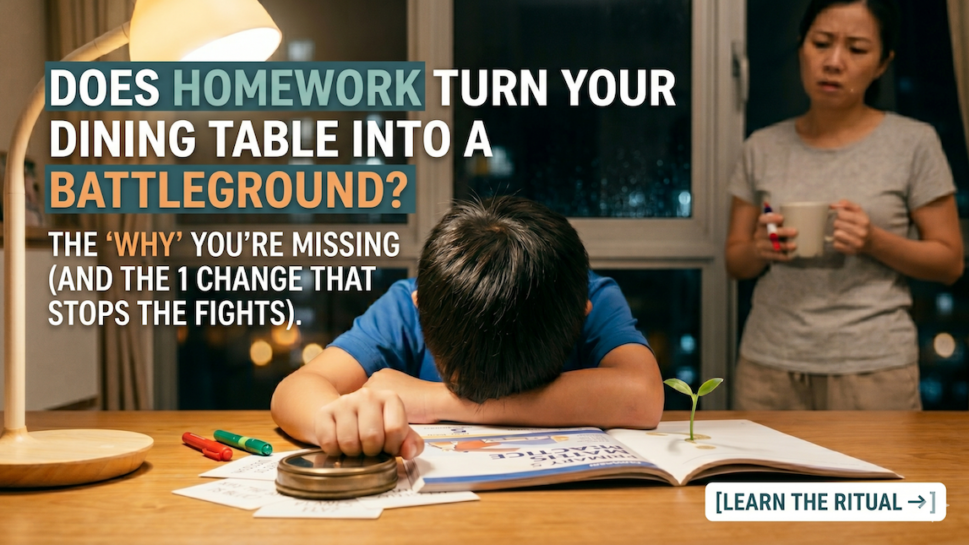
The front door opens, the school bag hits the floor with a heavy thud, and within ten minutes, the atmosphere in the house shifts. You know the feeling. It’s the “Homework Battle.”
Whenever the assessment book comes out, they start to
- complain,
- procrastinate, or
- develop a sudden, mysterious stomach ache the moment.
I’ve talked to so many Singaporean parents who are exhausted. They’ve tried everything: setting up a dedicated study corner, using pomodoro timers, offering rewards, or when the frustration peaks, threaten to take away the iPad or the phone.
None of it works consistently. And you start to wonder:
- Is my child just lazy?
- Are they unmotivated?
I’m here to tell you: No, they aren’t.
Most “study tips” focus on the environment: the table, the lighting, the schedule. But the homework battle is almost never an environmental problem. It is an emotional one.
What the Battle is Actually About
When a child shuts down over homework, they aren’t being “difficult” for the sake of it. They are usually dealing with one of two things:
1. The Fear of Being Wrong (Anxiety)
Does your child sit there and produce nothing? Do they erase their work constantly until the paper is thin? Do they say “I don’t know” before they’ve even finished reading the question? This is perfectionism. They are so afraid of the shame of a wrong answer that their brain literally freezes to protect them. This isn’t laziness; it’s a high-stress response.
2. Disconnection from Meaning (The “Why”)
Does your child rush through the work carelessly, doing the absolute bare minimum just to get it over with? Do they ask, “Why do I even need to know this?” This isn’t a “bad attitude.” It is a genuine, logical question. If a child doesn’t see how a worksheet connects to their real life or their own interests, their brain sees the task as a waste of energy.
The One Question That Changed Everything
When I was homeschooling my children during their preschool years, I didn’t have a rigid 9-to-5 schedule. What I had was a ritual.
Every single day, before we opened a single book or touched a single activity, I asked them one question:
“What are you curious about today?”
I didn’t ask what they needed to study. I didn’t ask what was on the “syllabus.” I just wanted to know what was happening inside their heads.
Some days, they were curious about why the sky was blue. Other days, it was about how aeroplanes stay up in the air or why ants walk in a straight line. We would start there. I’d let them lead. And then, I would gently find a way to connect their curiosity to the science or the language work we needed to do.
That question did something powerful. It reminded them that learning begins with them—with their own minds—not with a worksheet.
On the days they said, “I’m not curious about anything,” that was vital information for me too. It usually meant they were tired, overwhelmed, or anxious about something else. It told me that pushing a worksheet right then would be a waste of time because the “learning gate” in their brain was closed.
How to Use This for School-Going Kids
Now, I’m not suggesting you pull your kids out of school to homeschool them. We live in Singapore; we have a syllabus to follow and exams to pass. But you can take the spirit of that curiosity and bring it into your evening routine.
1. The Five-Minute Decompression
After school, before the school bag even opens, give them five minutes. Don’t ask about their spelling test or their math marks. Talk about something they found interesting. A joke a friend made, something they saw at recess, or a random thought they had on the bus. Let them feel like a person first, and a student second. When a child feels heard and seen as an individual, they bring a completely different emotional state to the homework table.
2. Ask “What were you thinking?”
When they eventually get to the work and they make a mistake, don’t reach for the red pen or the eraser immediately. Ask: “What were you thinking when you wrote that?” This does two things: it removes the “shame” of being wrong, and it reveals exactly which of those learning gaps I mentioned in my previous post is causing the trouble.
What This Will Not Fix
I want to be very honest with you, parent to parent.
This approach won’t fix everything. If your child has significant learning gaps that have piled up over years, or if they are in the high-pressure “crunch time” leading up to the PSLE, they need more than just a chat. They might need professional intervention or targeted support to catch up.
But for the daily homework grind? Rebuilding that connection to their own curiosity is the only way to stop the fighting.
Rebuilding the Connection
The homework battle isn’t about the math problem or the science MCQ. It’s about a child who has lost the link between their own natural curiosity and the work in front of them.
Our job as parents isn’t to force the work. It’s to help them find that link again—small moment by small moment, question by question.
If Science is the specific subject where your child has completely shut down, where the content feels like a mountain and the marks keep disappointing, I’d love to show you what a different kind of lesson looks like. At PowerPlay Edu Lab, we lead with curiosity and thinking techniques, not just drills.